Stainless steel surfaces demand epoxy products that deliver strong bonds, corrosion resistance, and reliable cures. This guide highlights five top epoxy solutions crafted for stainless steel repairs and coatings, from steel-reinforced putties to cold-weld epoxies and spray coatings. Each option is evaluated for performance, curing times, temperature tolerance, and ease of use, helping pros and DIYers choose the best epoxy for stainless steel applications. The selections emphasize reliability, versatility, and long-term durability across automotive, marine, and household repair scenarios.
| Product | Brand | Type | Key Benefit |
|---|---|---|---|
| J-B Weld SteelStik Epoxy Putty | J-B Weld | Steel Reinforced Epoxy Putty | Fast-setting, potable-water-safe |
| Rust-Oleum Stainless Steel Epoxy Spray Paint | Rust-Oleum | Epoxy Spray Coating | Scratch and abrasion resistance |
| Vicpricme High-Strength Epoxy Glue | vicpricme | Two-Part Epoxy Glue | High shear strength, versatile bonding |
| J-B Weld Original Cold-Weld Epoxy | J-B Weld | Two-Part Cold Weld Epoxy | High-strength steel-reinforced repairs |
| Blue Magic QuikSteel Epoxy Putty | Blue Magic | Epoxy Putty | Fast set, steel-reinforced |
J-B Weld SteelStik Epoxy Putty
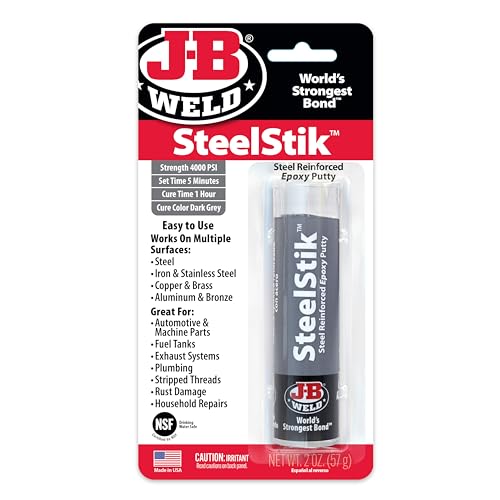
J-B Weld SteelStik is a hand-mixable two-part epoxy putty that is steel reinforced and non-rusting. It is NSF certified and safe for contact with potable water, making it suitable for water-related repair work on stainless steel components. After kneading the two-part formula, SteelStik sets in about five minutes and fully cures in one hour, providing a strong, durable bond. The cured material offers a lap shear strength around 900 psi and tolerates continuous temperatures up to 350°F (176°C), with intermittent resistance up to 450°F (232°C). It can be molded, shaped, sanded, drilled, and tapped, making it versatile for patches, rebuilds, and custom fabrications on stainless steel parts.
Common applications include repairing cracks in brackets, sealing leaks in metal housings, rebuilding worn threads, and quick-soon fixes on machinery where a metal-to-metal bond is required. Its ease of use—no mixing tools beyond kneading by hand—helps beginners apply repairs in tight spaces. While ideal for many indoor and outdoor metal tasks, cleanup requires standard solvents before fully cured; once cured, it provides a robust, machinable surface suitable for finishing operations.
Rust-Oleum Stainless Steel Epoxy Spray Paint

Rust-Oleum Specialty Appliance Epoxy Spray Paint offers a tough coating with superior abrasion and scratch resistance, designed to protect stainless steel appliances and metal surfaces. The spray applies as a durable epoxy coating that adheres to clean metal and provides Rust-Oleum Stops Rust protection. This option is ideal for refinishing dull or scratched stainless steel surfaces or providing a protective layer against corrosion in humid or chemical environments. Proper surface prep—cleaning, degreasing, and light sanding—helps maximize adhesion and finish. Curing times vary with environmental conditions, so adequate ventilation and temperature control improve results.
While spray coatings are not a repair putty, they are excellent for presenting a uniform, corrosion-resistant exterior on panels, housings, and decorative pieces made from stainless steel. It is particularly beneficial when refurbishing appliances, hardware, or automotive components that require a sleek, durable finish without bulk repairs. For best results, multiple thin coats are recommended over a single heavy application, allowing adequate drying and curing between passes.
Vicpricme High-Strength Epoxy Glue

The Vicpricme High-Strength Epoxy Glue is a two-component epoxy adhesive with a 1:1 mixing ratio in a 1.76-ounce syringe. It sets in about five minutes and fully cures in 24 hours, producing a strong bond that can reach up to 4,680 psi. It is designed to bond metal, including stainless steel, along with aluminum, copper, iron, wood, plastic, and glass. The cured epoxy is drillable, sandable, and paintable, and withstands temperatures from -65°C to 287°C. This makes it suitable for automotive, marine, and industrial repairs where a robust, heat-tolerant bond is required.
Typical uses include repairing radiators, water pipes, tanks, and cargo fittings, as well as fastening or sealing components on heavy equipment. The universal compatibility and quick initial set support efficient field repairs, while the high cured strength ensures long-term durability under vibration and exposure to chemicals. It is a practical option for practical, on-site fixes where traditional welding is impractical or unsafe.
J-B Weld Original Cold-Weld Epoxy
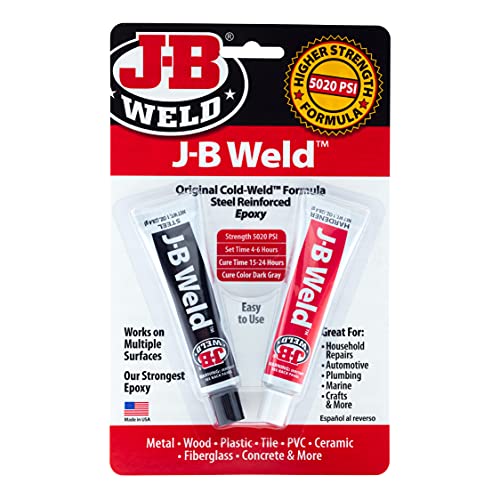
J-B Weld Original Cold-Weld Epoxy is a two-part epoxy system designed as an alternative to torch welding. This steel-reinforced formulation provides strong, lasting repairs across multiple surfaces and is widely used for household, automotive, marine, and DIY projects. After mixing at a 1:1 ratio, it takes about 4-6 hours to set and 15-24 hours to cure. Once cured, it can be tapped, filled, sanded, molded, and drilled. The set and cure color is dark grey, and the repair bond can withstand high temperatures up to 550°F (287°C). The waterproof and chemical-resistant properties make it suitable for exterior and interior metal repairs where a durable seal is essential.
The Original Cold-Weld is favored for heavier repairs such as patching cracked metal frames, repairing structural brackets, and restoring worn tabs where traditional welding is not feasible. Its steel-reinforced composition provides a robust bond that mimics welded joints, making it a dependable option for metal-to-metal repairs in demanding environments.
Blue Magic QuikSteel Epoxy Putty

Blue Magic QuikSteel QuikSteel Epoxy Putty is a steel-reinforced epoxy putty designed for fast repairs. This 2-ounce putty sets in about five minutes and cures to a solid gray in roughly one hour, delivering a quick, durable fix for metal surfaces. It tolerates high temperatures (up to 500°F) and bonds well to stainless steel, making it suitable for patching leaks, sealing seams, and rebuilding damaged fittings on pipes and containers. The putty can be molded to fit irregular shapes, then sanded and painted once cured, providing both strength and a presentable finish for metal components.
Applications include quick repairs on automotive parts, boat fittings, radiator housings, and metal fixtures. The rapid cure time makes it ideal for on-site field work where downtime must be minimized. Users should prepare the surface by cleaning and roughening to maximize adhesion, and follow curing times for best results. For larger repairs, applying the putty in layers helps achieve a strong, even bond across irregular gaps.
Buying Guide
When choosing epoxy for stainless steel, consider the repair type, required strength, and operating environment. Putty options are ideal for filling gaps, rebuilding edges, and quick field repairs, while two-part epoxies excel in creating strong, load-bearing bonds. Coatings and sprays provide protective finishes that resist corrosion and wear but may not repair structural damage.
- Bond Type and Strength: Choose putty for gaps and rebuilds, and two-part epoxies for permanent joints. Look at cure strength (psi) and the ability to withstand vibration and impact on stainless steel components.
- Temperature and Chemical Resistance: If the part experiences heat or exposure to oils, fuels, or cleaners, verify the epoxy’s temperature range and chemical compatibility.
- Set Time and Full Cure: Short-set products reduce downtime, but ensure a full cure to achieve maximum strength. Consider workability time for complex shapes.
- Surface Preparation: Clean, dry, and lightly roughen stainless steel surfaces for better adhesion. Some products require degreasing or sanding prior to application.
- Application Method: Putty or syringe-based epoxies offer different workflows. Sprays and coatings are best for surface protection and finishes rather than structural repairs.
- Finish and Machinability: If you plan to sand, drill, or paint the bonded area, confirm that the cured epoxy is machinable and paintable.
- Certifications and Safety: NSF or food-grade certifications matter for potable-water contact or food-contact surfaces. Follow safety guidelines for mixing and curing in enclosed spaces.
Across stainless steel applications—from automotive brackets to marine hardware—the right epoxy balances strength, cure time, and environmental tolerance. Users should assess the specific repair scenario, including exposure, load, and finish requirements, to select the most suitable epoxy solution. By combining product performance data with practical application guidelines, buyers can achieve durable, corrosion-resistant repairs that stand up to real-world conditions.