The right sliding miter saw blends affordable pricing with solid cutting performance, delivering accurate crosscuts, reliable bevels, and easy setup for DIY projects and light professional work. The following five models offer strong value, combining essential features with dependable build quality. They’re well-suited for trim work, cabinetry, framing, and general woodworking tasks where a balance of price and capability matters. Use this guide to compare capabilities and choose the saw that fits your shop size, typical materials, and workload without sacrificing accuracy.
| Product | Brand | Notable Feature |
|---|---|---|
| SKIL MS6305-00 | Skil | Dual Bevel, 4 positive stops, LED shadow line |
| DOVAMAN Updated 10-Inch Sliding Miter Saw | DOVAMAN | Ambidextrous design, dual-speed, laser guide |
| VEVOR Sliding Compound Miter Saw | VEVOR | LED alignment, axial sliding, aluminum base |
| Evolution R185SMS+ | EVOLUTION | Multi-material cutting, 0–45° bevel, 50° miters |
| Marvtool 10-Inch Sliding Miter Saw | MarvTool | 15A motor, 4,800 RPM, extension table |
SKIL 10-Inch Dual Bevel Sliding Compound Miter Saw MS6305-00
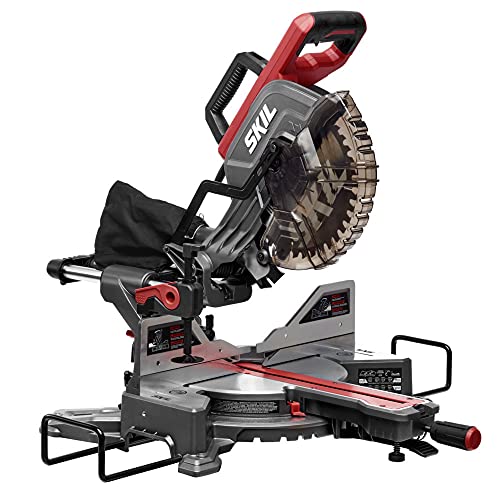
The SKIL MS6305-00 uses a 15-amp motor delivering up to 4,800 RPM to handle common wood-cutting tasks quickly. Its dual bevel enables cutting with left and right angles without flipping the workpiece, supporting 48° and 45° left and right positions with multiple positive stops. An integrated LED shadow line aids alignment, reducing guesswork when setting up cuts. The machined base and fence provide stable support for repeatable results, making it a strong value option for builders who need dependable performance at a reasonable price.
In practice, the SKIL model emphasizes straightforward operation and reliability. Its compact footprint helps in smaller shops, while the detent system and solid fence help minimize alignment drift during longer jobs. For hobbyists upgrading from a basic miter saw, or for small workshops that require consistent trim and framing cuts, this saw offers a balanced mix of features, accuracy, and value. The included components and ease of use make it a practical starting point for expanding a sliding saw setup.
DOVAMAN Updated 10-Inch Sliding Miter Saw

The DOVAMAN model offers dual-speed operation, switching between 5000 RPM for faster crosscuts and 3200 RPM for precise finishing. It ships with three TCT blades (two 40-tooth and one 48-tooth) designed for varied materials, expanding cross-cut versatility without swapping tools. An ambidextrous design enhances comfort for both left- and right-handed users, while a built-in laser guide assists with alignment for repeatable accuracy. The saw supports bevel cuts from 0 to 45 degrees and can handle a maximum crosscut around 3.5 by 13.4 inches, enabling significant material processing in tighter spaces.
Additional design considerations focus on practical workflow: a sturdy vise clamp secures stock, and an adjustable base facilitates fine-tuning for consistent results. The included blades and straightforward setup contribute to overall value, particularly for hobbyists cutting a mix of woods, plastics, and soft metals. While premium models boast more features, the DOVAMAN stands out for users who want adaptability, speed, and multi-material capability at a competitive price point.
VEVOR Sliding Compound Miter Saw

VEVOR’s miter saw emphasizes precision with an LED guide system that projects clear cutting lines for accurate results. The combination of a reliable locking system and a precise scale helps set miters and bevels with minimal trial cuts, reducing waste. An axial sliding mechanism enables forward and backward movement for wider crosscuts, which is especially helpful when working with longer boards or wider stock. The upgraded aluminum base keeps the tool lighter while improving heat dissipation and rigidity, contributing to steady performance during extended tasks without the heft of traditional cast-iron bases.
For space-conscious workshops, the VEVOR saw offers a compact footprint and a rail design that allows positioning close to a wall, freeing floor space. The aluminum construction enhances portability and ease of transport between jobsites or storage areas. As a value-focused option, it blends contemporary features with practical design to support a broad range of cutting tasks while keeping cost in check for hobbyists and small shops alike.
Evolution R185SMS+ Sliding Miter Saw

The Evolution R185SMS+ stands out for multi-material cutting capability, leveraging Evolution’s patented cutting technology to tackle wood, plastic, and certain metal components with minimal sparks, heat, or burrs. The saw features a 210 mm slide for ample cutting capacity and bevel and miter ranges that cover common angles—0 to 45 degrees bevel and up to 50 degrees in either direction. A 7-1/4-inch blade is included, providing immediate usability out of the box. The model comes with a three-year warranty, reflecting Evolution’s emphasis on durability and long-term value for budget-conscious buyers who need versatility beyond pure woodworking tasks.
Compared with premium models, the R185SMS+ prioritizes material flexibility and reliability over today’s most advanced electronics or ultra-smooth dust collection. It’s well-suited for shops that regularly mix materials or require a single tool capable of handling diverse cuts. The combination of a robust warranty, broad material compatibility, and a straightforward design makes it an appealing option for hobbyists and small workshops seeking a durable, value-oriented choice.
Marvtool 10-Inch Sliding Compound Miter Saw

The MarvTool sliding miter saw features a robust 15-amp motor with a no-load speed of up to 4,800 RPM, delivering solid cutting power for wood, plastics, and laminates. It uses a single bevel from 0 to 45 degrees and includes an extension table to widen the work area for longer crosscuts. A 36-tooth blade is included, along with a transparent blade guard and a dust bag to keep the workspace clean. The design focuses on straightforward operation and dependable performance at a value-friendly price point, making it a practical option for users prioritizing capability and affordability in a single saw.
For users who regularly work with varying stock sizes, the extension table expands cutting capacity without requiring extra clamping accessories. The vise clamp helps secure material for accurate cuts, though the model emphasizes ease of use and durability over high-end features. The result is a versatile, budget-conscious choice suitable for trim work, cabinetry, and basic framing tasks in a home shop or small shop environment.
Buying Guide: Key Purchase Considerations And Quick Comparisons
- Blade size and motor power: A 10″ or 12″ blade defines the maximum crosscut width. Larger blades commonly handle thicker stock, while higher amperage (15A) provides more power for dense woods and repeated cuts. For value-focused use, a 15A motor with a 10″ or 12″ blade typically offers the best balance between power and price.
- Bevel and miter ranges: Look for 0–45 degree bevels (or more) and wide miter angles to accommodate common framing and trim cuts. Positive stops at key angles improve repeatability and speed. Ambidextrous or easily adjustable bevel controls can aid in tight quarters or when working from different orientations.
- Sliding capacity and rail length: The sliding feature increases crosscut capacity, important for wide boards and larger components. Measure the maximum cut length and consider whether the saw can handle your typical stock widths without repositioning.
- Dust collection and cleanup: Effective dust containment reduces cleanup time and improves visibility. Check for integrated ports or compatibility with shop vacs, especially in basements or garages with limited ventilation.
- Base construction and stability: Aluminum bases are lighter and often adequate for most tasks, while cast-iron bases can dampen vibration and improve stability for heavy-duty cuts. Choose based on expected workload and portability needs.
- Accessories and blades: Some models include extra blades, extension tables, or clamps. Consider whether these add value for your projects, and whether you’re likely to upgrade blades for different materials.
- Ambidextrous design and ergonomics: Ambidextrous features can reduce fatigue for users who switch hands or operate in tight spaces. Ergonomics matter for longer sessions and for reducing cut errors over time.
- Warranty and reliability: A longer warranty generally signals durability and manufacturer confidence. For value buyers, a 3-year warranty can provide assurance against early failures during typical home-shop use.
When choosing among these options, consider your typical workload, material variety, and workspace constraints. Value-oriented saws often emphasize essential accuracy, ease of use, and reliable performance rather than premium refinements. If you anticipate cutting a wide range of materials or require extended capacity for larger projects, compare the sliding range, blade size, and bevel/miter flexibility across models. For hobbyists updating from a basic chop saw, a mid-range sliding miter with ambidextrous features and a robust fence may offer the best blend of performance and cost over the long term.