Choosing the right 3D scanner for construction projects can streamline planning, modeling, and inspection workflows. The following selections emphasize metrology-grade accuracy, fast scanning speeds, and robust performance on varied materials and surfaces. Each product is evaluated for on-site use, durability, and compatibility with common design software. This guide compares five top options to help professionals pick a reliable tool for as-built surveys, reverse engineering, and quality control across industrial sites and construction projects.
| Product | Key Strength | Typical Use | Surface Handling |
|---|---|---|---|
| Revopoint MetroX 3D Scanner | 0.01 mm min precision; 60 fps | Industrial measurement, metrology, dark/shiny parts | Blue laser; good on difficult surfaces |
| Revopoint MIRACO Plus | 0.02 mm precision; full-color capture | Small-to-large objects; detailed color textures | Photogrammetry mix; color fidelity |
| Creality Sermoon S1 | 0.02 mm accuracy; up to 90 fps | Engineering parts; large surface scanning | Blue and NIR structured light |
| Revopoint POP3 Plus | 0.04 mm precision; color scan | Medium objects; portable on-site scans | Color texture; mobile-friendly |
| Creality Raptor Pro | 0.02 mm precision; 660k points/s | Industrial inspection; reverse engineering | Dual blue laser and NIR tech |
Revopoint MetroX 3D Scanner for Metrology

The MetroX model is designed for high-precision industrial scanning with a blue laser approach. It advertises accuracy up to 0.02 mm and a fused point cloud distance around 0.05 mm, supporting precise measurements essential for QA and as-built documentation on construction sites. Its four scanning modes—Cross Lines, Parallel Lines, Full-field, and Auto Turntable—enable versatile object coverage from small mechanical parts to large components. The system is optimized for dark or shiny surfaces with GPU-accelerated, 14-line blue lasers delivering up to 60 fps, helping teams capture rapid, high-detail data without spray. Users should observe laser safety guidelines for Class 2M devices.
With Windows and macOS compatibility, MetroX suits teams needing classroom-like accuracy in field environments. Practical on-site benefits include metrology-grade scans of metal molds, machinery, and formwork components, plus automatic alignment and efficient post-processing. The device supports automated workflows and can reduce the time spent on manual measurements during site surveys. In complex projects, MetroX can complement traditional LIDAR by delivering dense point clouds for targeted regions needing exact geometry.
Revopoint MIRACO Plus 3D Scanner

The MIRACO Plus emphasizes high-accuracy scanning with photogrammetric metrology. It enables detailed capture for small-to-large objects with a photogrammetric kit that includes scale bars and coded targets, aiding measurements across large construction components. The device claims improved single-point cloud accuracy by about 20% with a calibration board and a 0.04 mm single-point precision in some configurations. Enhanced optics and a 48 MP RGB camera deliver vibrant color scans for textured models. This model is suitable for projects where color texture informs finishes, coatings, and as-built visualization, though it may require more setup work for optimal photogrammetry integration.
Creality Sermoon S1 for Engineering Projects

The Sermoon S1 combines dual-mode scanning with a high-speed capability. It uses a 34-line laser grid and multiple modes to capture complex geometries, such as deep holes and recessed areas, with reported metrology-grade accuracy around 0.02 mm. The system features 90 fps performance for efficient data capture and an NIR structured-light option for larger objects or body-like scans. This balance of speed, precision, and surface versatility makes Sermoon S1 well-suited for mechanical assemblies, automotive prototypes, and large-scale on-site measurements where rapid turnaround is favored.
Revopoint POP3 Plus 3D Scanner
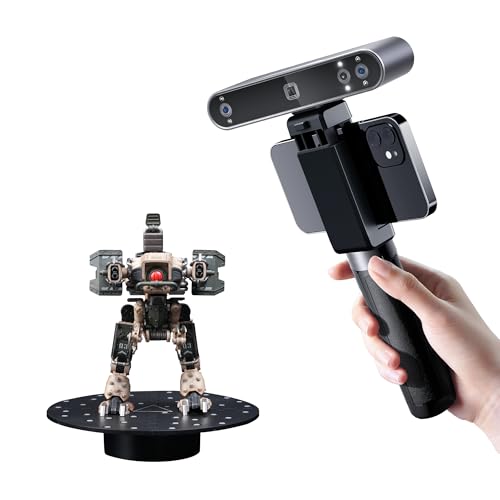
The POP3 Plus offers color scanning with improved accuracy up to 0.04 mm and a calibration setup designed to boost point cloud fidelity by about 30%. It supports Android, iOS, Windows, and macOS, enabling flexible field use with mobile devices. The solution integrates a high-definition RGB camera, flash LEDs for even lighting, and a 9-axis IMU to stabilize scans during现场 movement. For construction teams, POP3 Plus provides a portable option for mid-sized objects, interior spaces, and equipment components where color texture helps with inspection and handover documentation.
Creality Raptor Pro 3D Scanner

The Raptor Pro combines metrology-grade accuracy with fast scanning speeds and a robust dual-laser system. With 0.02 mm precision and up to 660,000 points per second, it is positioned for industrial inspection, reverse engineering, and detailed modeling of large components. The dual laser layout (22 cross lines and 7 extra lines) improves coverage for midsize to large objects, reducing the need for multiple passes. NIR structured-light scanning supports non-marker workflows, and a dedicated body/face mode enables quick human-form captures. This scanner is well-suited for automotive components, machinery housings, and architectural surfaces requiring precise geometry capture.
Matterport Pro3 Lidar Scanner

The Matterport Pro3 is designed for large indoor and outdoor spaces, offering lidar-based scanning with a broad capture range up to 100 m in extended scans. It emphasizes rapid, high-precision capture for virtual tours and architectural walkthroughs, making it a strong option for large construction sites, facilities management, and real estate development. The Pro3 integrates 4K photography and a professional-grade sensor to create photorealistic, accurate digital twins suitable for BIM workflows. While optimized for large-scale spaces, it complements handheld scanners when thorough coverage and fast deployment are priorities on job sites.
Buying Guide: Key Purchase Considerations
Choosing a construction-focused 3D scanner involves evaluating accuracy, speed, surface compatibility, portability, and software ecosystem. Consider the following factors:
- Accuracy and resolution: For as-built documentation and QA, prioritize devices advertising 0.02–0.04 mm precision. Higher precision reduces post-processing corrections and rework.
- Speed and data density: On-site surveys benefit from fast capture (fps) and high point density to minimize man-hours. Some models offer 60–90 fps or more with multi-laser arrangements.
- Surface handling: Dark, shiny, or translucent surfaces pose challenges. Blue lasers and structured-light systems vary in effectiveness; consider posting spray or preparatory steps if necessary.
- Portability and workflow: Field surveys require handheld or portable scanners that pair with mobile devices or rugged laptops. Check battery life and weight for extended field use.
- Color vs. geometry: Color texture aids visualization and BIM mapping but may add processing load. If texture is less critical, prioritize geometry accuracy and speed.
- Software compatibility: Ensure the scanner exports compatible formats (OBJ, PLY, LAS, etc.) and integrates with BIM, CAD, and point-cloud processing tools used on site (Revit, AutoCAD, Civil 3D, Faro TS, etc.).
- Calibration and targets: Some systems rely on photogrammetric targets or calibration boards. Assess the time needed for initial setup and ongoing maintenance.
- Pricing and maintenance: Consider total cost of ownership, including replacement parts, software subscriptions, and training resources.
In practice, for construction workflows, a combination approach often yields the best results: a high-precision handheld unit for as-built geometry and an auxiliary color-capable scanner for texture and context. For very large sites, a lidar-based solution or a professional-grade fixed-lidar setup may complement handheld devices to capture expansive interiors efficiently. Assess project scope, site conditions, and BIM requirements to select a model that balances accuracy, speed, and portability.